

Carla H. McIntosh and the Quiet Work of Leading Talent
In this HIGHER series, we spotlight talent acquisition leaders whose work reflects the realities of today’s market—leaders operating inside leaner teams, rising expectations, and rapid shifts in how hiring, leadership, and technology intersect.
This leadership feature focuses on Carla H. McIntosh, a longtime TA executive whose career spans the U.S. Air Force, agency recruiting, Google, and Reddit, where she served as the company’s first Vice President of Talent Acquisition and Contingent Workforce through its IPO.
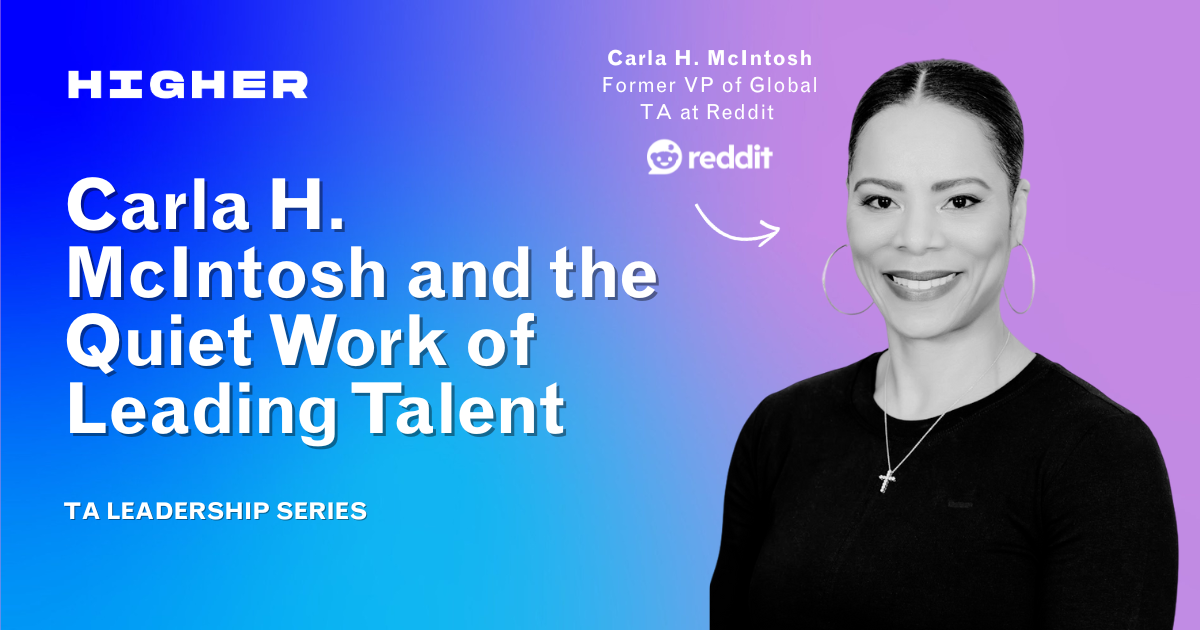
McIntosh’s career has unfolded across highly structured and deeply ambiguous environments. Today, she advises founders, supports TA leaders through community work, and serves on the board of AnnieCannons, a nonprofit that trains survivors of human trafficking for careers in tech. What makes her perspective especially relevant now is not a single role or company, but the way she approaches leadership when the margin for error shrinks.
Calm Under Pressure
Before she ever led recruiting teams, McIntosh worked in air defense in the U.S. Air Force. She helped control fighter jets, coordinated in-flight emergencies, and supported missions where decisions had to be made in seconds. Communication was recorded. Accuracy was non-negotiable. Emotional regulation was part of the job.
That experience still shapes how she leads today, particularly in moments when talent leaders absorb urgency from every direction.
“I still find myself giving myself the pep talk,” she says. “Carla, you’re not saving lives in this job. You can handle this.”
For senior TA leaders, the line resonates. The work carries real consequences, but panic rarely improves outcomes. McIntosh’s calm is not performative or passive. It is practiced. It allows her to slow conversations down, create clarity where there is noise, and steady teams when pressure mounts.
A Career She Didn’t Plan
McIntosh did not set out to work in talent acquisition. After leaving the military, she worked in data operations at British Petroleum in Anchorage before relocating to San Antonio. A cold call led her to Robert Half International, where she arrived hoping to be placed in a role and instead was recruited into recruiting.
The work felt familiar almost immediately. The pace, the precision, and the need to stay composed while managing competing demands mirrored environments she already knew how to navigate.
“Recruiting rewarded the same skills,” she says. “Adaptability, clarity, and composure under pressure.”
Those qualities, she notes, have only grown more important as TA roles have expanded beyond execution into leadership, strategy, and influence.
Choosing Range Over Comfort
One of the defining characteristics of McIntosh’s career is her resistance to staying narrow. Rather than anchoring her identity to a single specialty, she deliberately sought exposure across the talent ecosystem—L&D, Belonging & Inclusivity, operations, analytics, employment legal partnership, workflow strategy, and M&A work.
Her reasoning is pragmatic. Linear careers are fragile in an environment where roles consolidate and expectations broaden.
That philosophy shaped a pivotal decision at Google. McIntosh stepped out of a sizable people-leadership role into an individual contributor position aligned to Cloud recruiting, functioning much like a chief-of-staff program manager. Internally, the move raised eyebrows. It reset her perceived equity. It also exposed her to work most TA leaders never touch.
In that role, she supported major acquisitions, helped lead global diversity strategy development, wrote global recruiting OKRs, and facilitated calibration at significant scale. She later returned to people leadership with a broader operating system and sharper business fluency.
“A lot of leaders end up with the careers other people want for them,” she says. “I wanted the skills I didn’t have yet.”
Advocacy in the Rooms That Matter
McIntosh describes advocacy in practical terms, as part of leadership and decision-making rather than language or positioning.
In performance discussions, hiring conversations, and organizational reviews, narratives form quickly—often without the person affected in the room. Advocacy, in her view, means stepping in to slow those moments down: questioning assumptions, surfacing missing context, or challenging conclusions before they become decisions.
Much of this work is quiet and rarely visible. It depends on credibility and judgment, and it often means pushing back without needing recognition for doing so.
That expectation—advocating without cover or acknowledgment—connects to a broader reality for TA leaders today. Many are expected to be experts across every area of the function while having limited space to test ideas or admit uncertainty.
“A lot of TA leaders are not actually leading a team,” she says. “They’re on this island.”
That isolation helps explain why she places such emphasis on community, and why she continues to invest time advising, mentoring, and supporting leaders outside of formal reporting structures.
Designing for Flexibility at Scale
When McIntosh became Reddit’s first VP of Talent Acquisition and Contingent Workforce, she focused on principles that feel particularly relevant now.
She built teams for adaptability rather than rigid specialization. Recruiters were expected to support what the business needed, not remain tethered to narrow scopes.
She pushed a true one-team mentality. If one group missed hiring demand, the organization missed together. Teams that were ahead leaned in rather than disengaging.
She also emphasized business discipline: clear problem statements, fewer duplicative efforts, and earlier cross-functional alignment. Backfills became opportunities to revisit org design and leveling, not simply execute requisitions as written.
For senior TA leaders operating in leaner environments, her approach underscores a central point: flexibility is not a nice-to-have. It is structural.
What TA Leadership Requires Now
Over time, McIntosh has become more direct about something she learned the hard way: doing good work is not always enough.
“My whole career, I’ve been too modest, too humble,” she says.
Today, she talks openly about the need for TA leaders to explain their work as it’s happening. That means sharing priorities, naming tradeoffs, and showing progress before assumptions take hold. In doing so, the ongoing value of the TA function is more likely to be understood as critical, strategic, and directly tied to company success. It’s a theme she returns to often—not as self-promotion, but as a practical response to how organizations make decisions under pressure. That same realism shapes how she approaches technology. McIntosh supports automation and AI-enabled workflows, but she is clear-eyed about the gap between expectation and reality. “There is a very big gap between what people think AI can do and where it actually is today,” she says.
She sees part of the TA leader’s role as managing that gap—bringing context into conversations shaped by headlines, grounding AI discussions in real workflows, and setting expectations executives can actually hold teams to. “AI won’t replace recruiters,” she says. “It will replace process.”
Her focus on context extends to people as well. McIntosh raises concerns about ageism in TA, particularly for experienced leaders who are passed over based on assumptions about cost, curiosity, or adaptability. She points instead to an enablement gap, noting that organizations often invest heavily in early-career talent while overlooking the support needed to keep seasoned employees learning and engaged.
“You can be underutilizing a lot of seasoned, battle-tested talent,” she says.
Outside corporate TA, that belief carries into her work with AnnieCannons, where she supports pathways into tech for survivors of human trafficking. The throughline, she suggests, is not potential versus performance, but whether systems are designed to recognize what people bring with them.
When she talks to TA leaders navigating an uncertain market, her advice is consistent. Don’t wait to be invited into the work that matters. Raise your hand early. Stay close to the business. Make your value visible as you go. “You can’t be mad if you never get tapped,” she says.
For a function operating with fewer buffers and higher stakes, McIntosh’s leadership offers a clear example of how experience shows up: in knowing when to speak up, when to slow things down, and how to stay useful as the work keeps changing.
