

This guest post comes from T100 awardee Rory Mullins, Director of Talent Acquisition at CluePoints, who’s led TA in high-growth environments including Uber and Wise.
As companies grow, hiring often becomes harder, even when teams are doing the right things. Pressure builds inside the system as recruiter load increases, decisions slow down, and candidate experience starts to slip. Not due to lack of capability, but because hiring systems haven’t evolved with the business.
Keep reading to learn how Rory approaches designing TA systems that scale with growth, balancing speed, quality, and the human side of hiring.
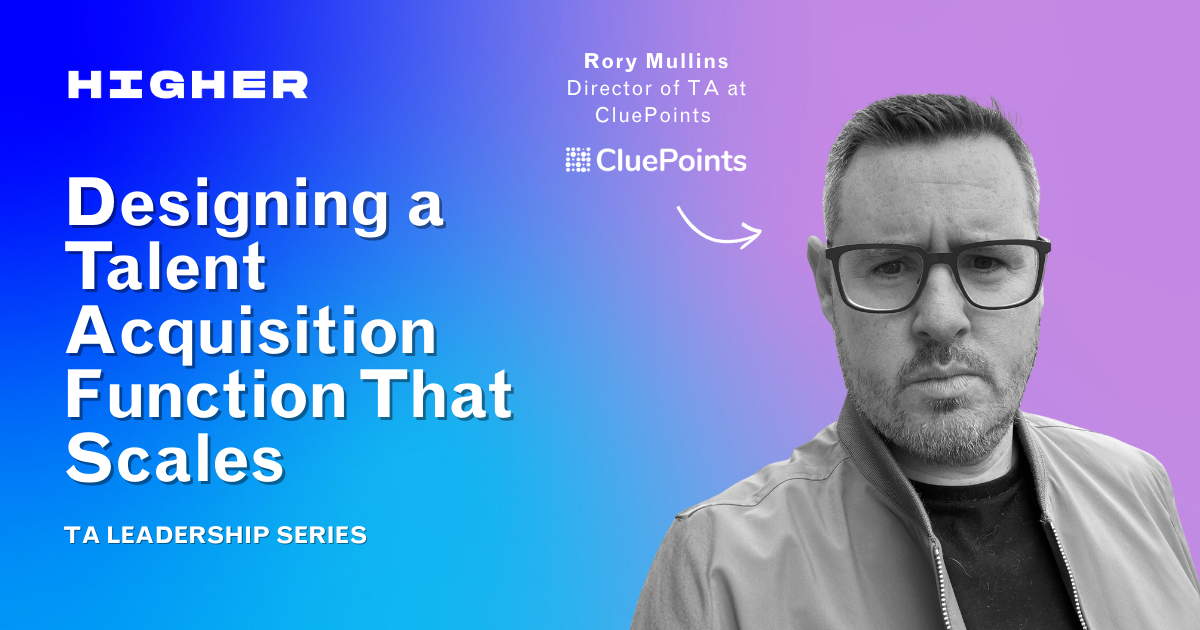
By: Rory Mullins, Director of Talent Acquisition at CluePoints
If you’ve ever scaled a TA function, you’ll know the feeling.
On the surface, things still work. Roles are open. Candidates are moving. Offers are going out. People outside TA assume it’s fine, because hiring is “happening”.
But inside the function, it starts to feel heavier. Recruiters carry more load. The business wants faster answers. Hiring managers get twitchy. Candidates start chasing for feedback. You end up spending more time unblocking the system than actually improving it.
That’s usually the moment TA teams get labelled as the bottleneck. And nine times out of ten, it isn’t because the team can’t do the job. It’s because the way hiring works hasn’t kept up with what the business is now asking it to deliver.
Effort scales for a while. Systems scale for longer.
One of the biggest traps in growth is believing hiring scales with effort. If recruiters work harder, we’ll keep up. If we just push a bit more, we’ll get through the quarter. If we add a tool, it’ll smooth it out.
That mindset can get you through short spikes. It won’t get you through scale.
When you’re growing, TA has to be designed like an operating system. That sounds fancy, but it’s basic. It means you’re clear on what you can deliver, how work moves through the system, and what you’ll do when the plan inevitably changes.
If those things aren’t explicit, TA becomes reactive by default. You can still fill roles, but you’ll do it with increasing stress, increasing noise, and gradually lower signal.
The first signs aren’t in your dashboards
I’m a big believer in data, but I’m also very aware it can lull you into a false sense of security.
The early signals that a hiring system is breaking are usually human:
A recruiter who is “fine” but clearly fried
Hiring managers going around process to agencies or direct to candidates
Candidates waiting too long for decisions, then dropping out
Feedback SLAs becoming optional because “we’re busy”
On paper, you can have a decent time-to-fill and still be doing long-term damage. That’s why when I join a business, I don’t start by building a deck. I start by talking to people. Recruiters, hiring managers, finance, whoever is close to the work.
Then I go into the ATS and look at one simple thing: where are candidates sitting, and for how long?
CV review is usually the canary. If candidates are piling up there, the issue is rarely “too many applicants”. It’s often that intake is weak, priorities are unclear, or the team simply doesn’t have the capacity the plan assumes they have.
The story plus the numbers gives you the truth.
Capacity planning is the job, not the spreadsheet
No hiring plan starts in January and finishes in December. I’ve never seen it happen. Priorities move. Leaders change their minds. New bets appear. Markets shift. That’s normal.
So the goal isn’t to create a perfect plan. The goal is to build a TA system that stays stable when the plan moves.
For me, that starts with capacity.
You don’t need a complex model to get the basics right, but you do need to be able to answer these questions without guessing:
How many hires can this team realistically deliver without breaking?
What does “good” look like for recruiter load in our context?
What happens when we add 20 roles mid-quarter because priorities shifted?
One thing I’ve found works well is building a “break glass” approach into TA budgets. Ringfence a portion of your hiring capacity budget for defined scenarios. If it doesn’t get used, it goes back. If it does, you can react without panic.
Some CFOs love this because it shows mature planning. Some don’t because they want certainty. But the reality is hiring has never been certain, and pretending it is just pushes chaos into the function later.
And honestly, it avoids one of the worst TA leadership experiences: building a perm team for an aggressive plan, then having to scramble when headcount tightens.
Sometimes the best scaling move looks like slowing down
Here’s the counterintuitive bit. If you want to scale, you often need to slow down in the right places.
A good example is recruiter alignment.
On paper, aligning recruiters purely by discipline can look efficient. Backend here. Frontend there. Design over there. It makes sense in a spreadsheet. In practice, it can create shallow context and transactional relationships with the business. Recruiters move quickly, but they don’t really get embedded in the teams they support.
When you align recruiters to squads or tribes, it can initially slow delivery. Recruiters carry fewer roles, spend more time in context, rebuild relationships, and understand the “why”, not just the “what”.
It feels slower at the start. But over time, the system improves because you stop hiring in a vacuum. Hiring conversations shift from “fill this vacancy” to “build this team”. Trust improves, decision-making improves, and you end up moving faster later because you’re not constantly reworking fundamentals.
That short-term slowdown buys long-term leverage.
Treat TA like a product function (because it is)
The strongest TA teams I’ve been part of aren’t the ones with the most tools or the flashiest employer brand. They’re the ones that operate like product teams.
They’re clear on who their users are (candidates and hiring managers). They run retros. They iterate. They make trade-offs visible. They care about outcomes, not activity.
A simple example: instead of obsessing over time-to-fill alone, focus on where candidates stall: time in CV review, time to decision, and stage-level bottlenecks.
Those metrics tell you where the system is under strain and who needs support. Where does the process slow down? Why? Who owns that stage? What do we change next week to fix it?
When TA works like this, you stop being a service desk and start being a lever.
AI can help, but only after you’ve done the boring work
AI has become a weird topic in TA. Half the market is saying it will replace recruiters. The other half is refusing to touch it. In reality, it’s neither.
AI doesn’t fix broken hiring systems. It amplifies whatever system you already have.
Where I’ve found it genuinely useful is in stripping out admin and creating consistency. Not glamorous, but high impact.
Examples that actually move the needle:
turning intake notes into a structured JD quickly
neutralising language and improving clarity
generating interview questions and rubrics aligned to the role
helping assess CVs against defined criteria, rather than gut feel
producing cleaner, more consistent candidate summaries for hiring managers
Individually, these save minutes. Together, they save hours per role and reduce cognitive load across the team. That’s real capacity.
One useful benchmark is agency standards. When I worked in agency, every shortlist had to be the recruiter’s best possible work: clear rationale, strong notes, and a compelling case for each candidate. Internal TA should hold itself to the same bar. AI helps make that standard scalable.
The test I use is basic: does this improve quality, increase capacity, or make decisions clearer? If not, it’s probably noise.
And one more point: if you’re buying AI tools before your intake is strong and your prioritisation is clear, you’re not innovating. You’re automating chaos.
Data should change behaviour, not decorate a board pack
I’ve seen too many TA dashboards that tell you what happened and nothing else. “We made 12 hires.” Great. So what?
High-performing functions use data to influence decisions in real time.
The metrics that tend to matter most are the ones that highlight friction and behaviour:
stage conversion
time to decision
recruiter load
offer acceptance trends
Used properly, data gives you the credibility to challenge the business, support consistency and clarity in decision-making, and stop prioritisation-by-noise.
The real goal is resilience
Scaling TA isn’t about perfection. It’s about building a system that can hold up when everything changes, because it will. That resilience also depends on investing earlier in internal mobility and upskilling, so future roles aren’t solved purely through external hiring.
If I had to boil it down, it comes back to a few foundations:
Design capacity before you promise outcomes
Build a process that can absorb change without breaking people
Treat hiring managers as partners, not customers, and enable them properly
Use tools (including AI) to remove friction, not to patch weak fundamentals
Use data to influence decisions, not just to report activity
None of this is flashy, but it’s what makes the difference.
And if you get it right, TA stops feeling like the thing that has to “keep up”. It becomes a function that helps the business scale with more clarity, more consistency, and a better experience for everyone involved.
If you’re in that messy middle right now, you’re not alone. Most teams are. The good news is the fixes are rarely magic. They’re usually just deliberate.
Connect with Rory Mullins on LinkedIn.
Have insights or lessons of your own to share?
Join the HIGHER community and add your voice to the conversation.