

TA leadership has moved well beyond measuring AI ROI by how fast a recruiter can draft an email.
As talent executives made clear across the HIGHER Altitude Summits in San Francisco and London, true financial return comes from protecting interviewer time, the organization's most constrained resource, and shifting from transactional task speed to talent intelligence.
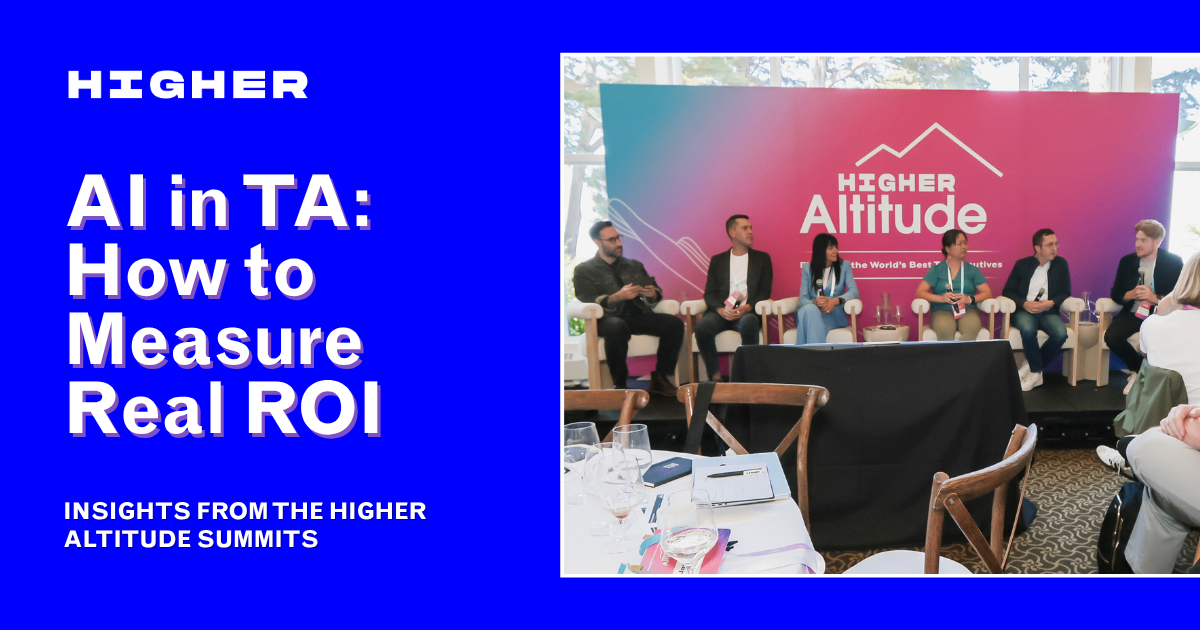
If your executive team or CFO is questioning the commercial yield of your talent tech stack, here is how TA leaders at Microsoft, Thoughtworks, Adobe, Databricks, and hyperexponential quantify real operating impact.
1. Reclaim High-Value Business Capacity
The largest financial bottlenecks in hiring sit outside the talent acquisition function. When senior engineers or business leaders spend hours on administrative interview notes, the company absorbs a direct hit to product velocity or billable revenue.
By implementing interview intelligence tools to transcribe and summarize candidate evaluations, Thoughtworks reclaimed 15 minutes of post-interview write-up time per candidate—saving thousands of billable client hours annually.
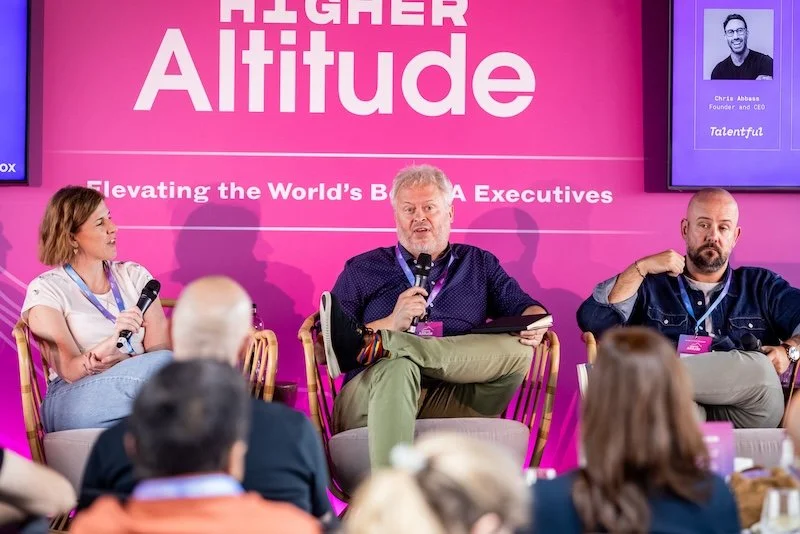
As Marcus Thorpe, SVP, Global Talent Acquisition at Thoughtworks, pointed out:
"My most valuable resource is interviewer time. We're constantly struggling because everyone's client-facing and they forget about HQ, and we need their time to interview at scale... Typically, it takes us about four months from start to finish to qualify out a requirement, to talk to HR, to get people to agree and to calibrate on what good looks like from an interview process, and we're now using AI to interpret previous feedback... and we're going from four months to three or four weeks."
2. Calculate the Cost of Inaction
Evaluating AI purely on software licensing costs ignores the financial drain of legacy, manual operations.
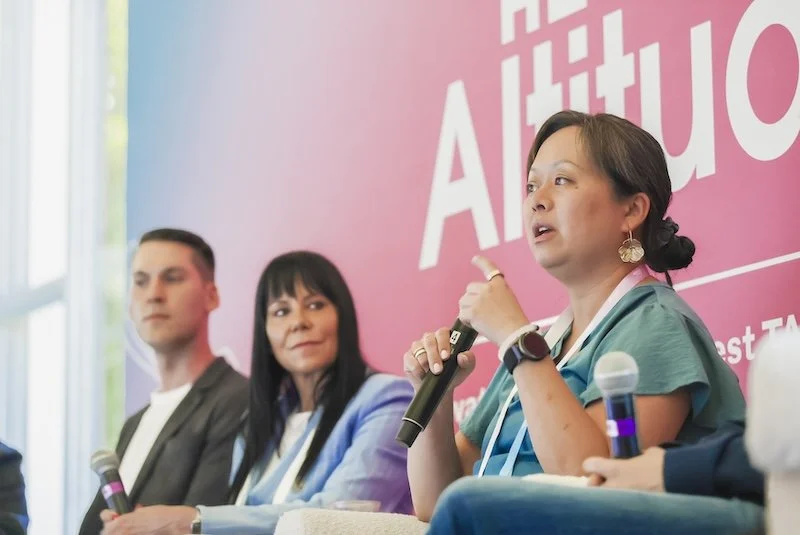
Amy Ho, Senior Director, Global Talent Acquisition Operations at Adobe, emphasizes that legal and risk teams often fixate on the perceived risks of deploying AI while ignoring the operational cost of sticking to manual processes:
"It's also not just about the cost of tokens. It's also what is the cost of not deploying the solution, right? ... Well, if we don't have an AI solution or AI to help assist in detecting fraud, in dealing with the exponential increase in volumes, well, what's the risk of not doing it? Are we reverting to cherry picking hires? Is that more or less risky?"
Relying purely on manual workflows introduces specific business risks:
Exposure to candidate fraud during technical screening.
Interviewer burnout caused by uncalibrated candidate pipelines.
Arbitrary selection when overwhelmed recruiters revert to cherry-picking resume stacks.
3. Measure Capacity Yield, Not Token Spend
Concerns over recruiters burning through expensive AI token budgets are largely misplaced. Siadhal Magos, Co-founder & CEO at Metaview, noted that heavy token consumption sits within engineering teams, not recruiting:
"I wouldn't place that as a limit on yourself. I don't think people are sitting there thinking, 'The recruiting team are burning through tons of tokens.' It's engineers that are burning through these tokens... I wouldn't come away from this being the person who's trying to rationalize everyone's token spend."

Instead, the focus should be on candidate conversion yield and data intelligence per team member. At Databricks, Cindy Nicola, Vice President Global Talent Acquisition, detailed how connecting Greenhouse, Anaplan, and Workday into an HR Lakehouse shifted their operating model:
"We've really been able to shift from maybe making recruiting faster and easier to actually making it smarter because we have that intelligence layer."
Approved requisitions feed directly into the system without manual TA setup, allowing recruiters to query real-time offer acceptance and attrition data through a conversational interface.
4. Distinguish Experimentation from Permanent Adoption
Testing prompts or attending software demos is not adoption. Real ROI requires a permanent shift in how work gets done.
Lucy Szypula, Head of Talent at hyperexponential, cautions against mistaking early excitement for operational impact:
"One of the biggest lessons for me is mistaking excitement and experimentation for adoption. Those are not the same things. For us, the goal for adoption is where it actually permanently changes the way you work."

Initial enthusiasm frequently collapses under high hiring pressure, with teams reverting to old habits. To drive lasting workflow changes, hyperexponential sets aside dedicated "AI Adoption Days" focused, half-day blocks where talent teams step away from candidate queues to build, test, and embed automations directly into their core routines.
The AI ROI Framework
What to Do Next
To anchor your AI strategy in commercial reality, take these four operational steps:
Audit interviewer friction: Calculate the exact hours your engineering and business teams spend writing post-interview feedback. Use that baseline figure to justify interview intelligence tools.
Build a cross-functional governance squad: Pair TA, HR Ops, Legal, and Finance in shared implementation squads focused on business outcomes rather than isolated departmental goals.
Invest in team judgment over rigid guardrails: Technology and compliance set the outer boundaries, but commercial judgment makes the system work. As Kate Parkinson, EMEA Talent Acquisition Lead at Microsoft, framed it:
"Look, the bread on either side is one end's the compliance, one ends the technology. What you stuff it with, that's the judgment... Really invest on building business acumen, capability, judgment with your teams, because that's where the magic is going to happen."
Establish adoption criteria: Stop tracking software logins. Measure process adoption by tracking specific operational shifts, such as the elimination of manual requisition creation or reduced intake meeting durations.